Taking a stroll along Daehak street, we find Seoul fighting for its voice. At its center stood Hakchon, a small theater like no other.

Hakchon Blue is a small theater located on Daehak street. Founded in 1991, Hakchon announced that it will close permanently in early 2024. In a small theater of just 200 audiences, an astounding line-up of artists gathered.
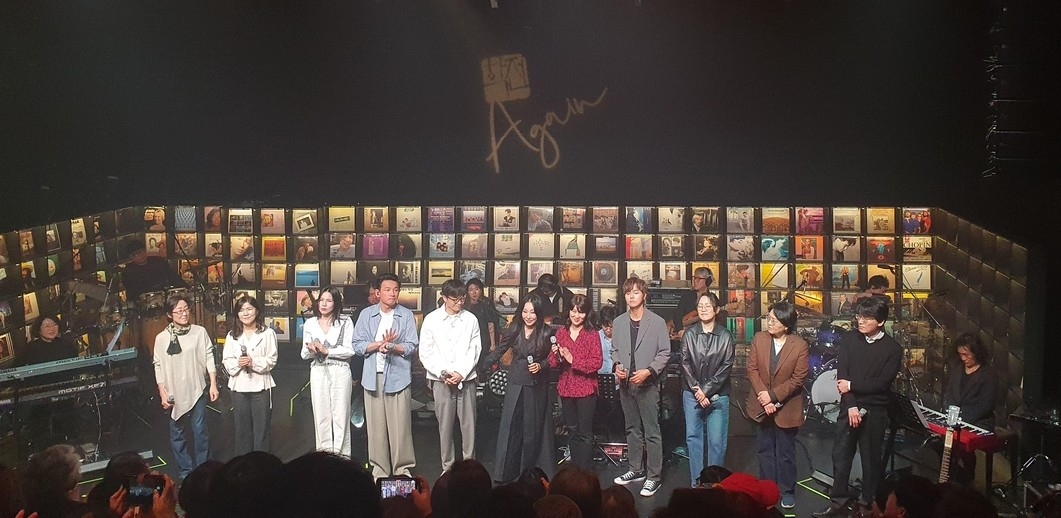
14 March 2024

Actor · 지하철 1호선

Musician · YB · 28 February 2024
Korea's leading actors, musicians, and radio hosts call this theater, smaller than an average school gym, home. To understand Hakchon and what it meant to its community, we zoom out to look at Daehak street.
This is Daehak-ro seen today. Scenic alleys and modern culture institutions line its streets, as well as SNU's medical complex.


Daehak-ro ("university street") is named due to Seoul National University's former presence. Keijō Imperial University, the direct precursor to SNU, was located on the street since the 1930s. SNU moved most of its operations to Gwanak in 1975, but the name Daehak-ro stuck around.
Daehak-ro's cultural identity was historically centered on student protest culture. It arguably begins in 1960, when nationwide protests against president Rhee's corruption swept Seoul. Daehak-ro served as a protest hotspot in which university students rallied on its streets.


The April 19th revolution involved a series of bloody crackdowns. On Daehak-ro, SNU students and intellectuals gathering in its campus led protests. The street's protest culture was anchored by SNU. Photographs attest to the university's role in defining Daehak-ro's public culture, showing medical students protesting in white gowns and professors joining the march less than a week into the revolution.
But nearing the 1980s, protest culture centered on SNU permeated through the street's gathering spaces. Daehak-ro's cultural identity was increasingly about the street's restaurants, cafes, Jazz diners and record stores. These were places where Seoul's youth gathered to debate politics. A faction of student protesters shaped their political identity on Daehak-ro ("The National Student Federation").


Hakrim Dabang, a cafe established in 1952, was a popular gathering place for student protest factions. The infamous Hakrim Incident of 1981, in which the military regime tortured and prosecuted dozens of protest faction members, is named after the cafe which served as the group's first meeting space.

Jinachun is a jajangmyeon restaurant established in 1925. It gained popularity among university students and medical staff in SNU hospital.
문화일보통금(야간통행금지)이 다 되도록 버티고 있는 학생고객에게 진아춘은 한없이 관대했다... 기억건대 그 주인장 얼굴에는 이번에 또 어떤 학생이 감옥에 끌려가려나 하는 근심이 서려 있었던 것 같다.
Jinachun was infinitely generous to students debating into the night, nearing curfew hours... I remember seeing a tinge of sadness on the shopowner's face, wondering which student would be arrested next.
As Daehak-ro's student protest identity matured, another trend quietly began to take shape. Dozens of independent theaters were founded, and the street's drama industry grew rapidly in the early 1990s.
As the 1980s came to an end, political movement culture was in decline. Korea moved rapidly towards democratization. The society surrounding Daehak-ro changed, but the people of Seoul found different ways to participate in public culture. Around this time, Daehak-ro's cultural identity shifted to drama and small-scale theaters.


The rise of theater in Daehak-ro overlaps with a change in protest culture, both taking place in the late 1980s to early 1990s. Rapid democratization decreased Daehak-ro's role as a protest hotspot, but theater culture flourished.
Daehak-ro's cultural identity changed. This is not a straightforward transition from protest movement to drama, but a gradual shift brought upon by the people using the street.
But one person connects the two cultures: Kim Min-Ki, a renowned folk/pop musician who would establish Hakchon in 1991.
김민기 · Kim Min-ki학전은 대중 문화를 만드는 못자리다
Hakchon is the seeding ground of popular culture
Kim Min-Ki was a renowned musician and composer known for blending Korean pop and folk styles. He composed his most famous title "Morning Dew" in 1970. The song was censored by the military regime for no clear reason. Over time, the song built an image of protest and defiance, representing the spirit of political rallies.

아침이슬 · Morning Dew
양희은 · Yang Hee-eun
Kim had a tumultuous youth under the military regime. Most of his titles were banned as they rose in popularity among protesters. He was framed as an anti-regime composer. He was barred from employment, could not publish titles, and even suffered torture.
Throughout this time, Kim tried to write children's musicals and other music for screenplay. Bans against his works of drama was eventually lifted in 1987 with democratization.


In 1991, Kim founded Hakchon Blue theater. He invested his own money, reportedly selling assets to pay upfront costs.


In 1994, Kim adapted the German musical Linie Eins to write 지하철 1호선 ("Line 1"). It became one of the most successful small-scale musicals in Korean drama history, and was even recognized internationally.
With 지하철 1호선 as its flagship work, Hakchon expanded its repertoire into the 1990s.


Posters from the Hakchon archive · various seasons
Hakchon wasn't just Daehak-ro's most successful theater. It left invaluable influence in the industry that would outlast its time. Hakchon launched scores of aspiring actors and artists into industry, and the so-called "Hakchon alumni" have become accomplished celebrities in acting, music, and other fields of entertainment.
Kim was personally devoted to improving working conditions for actors, too. Hakchon started the convention of signing work contracts with its performers, offering legal protection when most theaters in the industry paid little attention.
Daehak-ro's dominant cultural identity shifted from student protests to performative art. The process was driven by Seoul's young artists and independent theaters. Underlying that change, however, is Seoul's continued desire to participate in public culture. Facing rapid changes in society (such as democratization), the people of Seoul adapted and learned to reshape its cultural identity. Daehak-ro's evolution is a telling example of how Seoul's citizens recognized different facets of public culture, responded to changes that lie outside direct control, and built a cultural identity around how its space is used.
황정민 · 14 March 2024학전은 오늘로 사라지지만 그 정신은 모든 사람, 배우, 관객이 가지고 있을 겁니다.
Though Hakchon closes its doors today, its spirit will live on in every actor and audience member.
Images & sources
AI use disclosure
AI was not used to write the essay’s text contents or develop its structure.
AI was used to implement this website in html/css/js code, following detailed UI instructions from the author and manual debugging/review. The interactive elements were planned by the author.